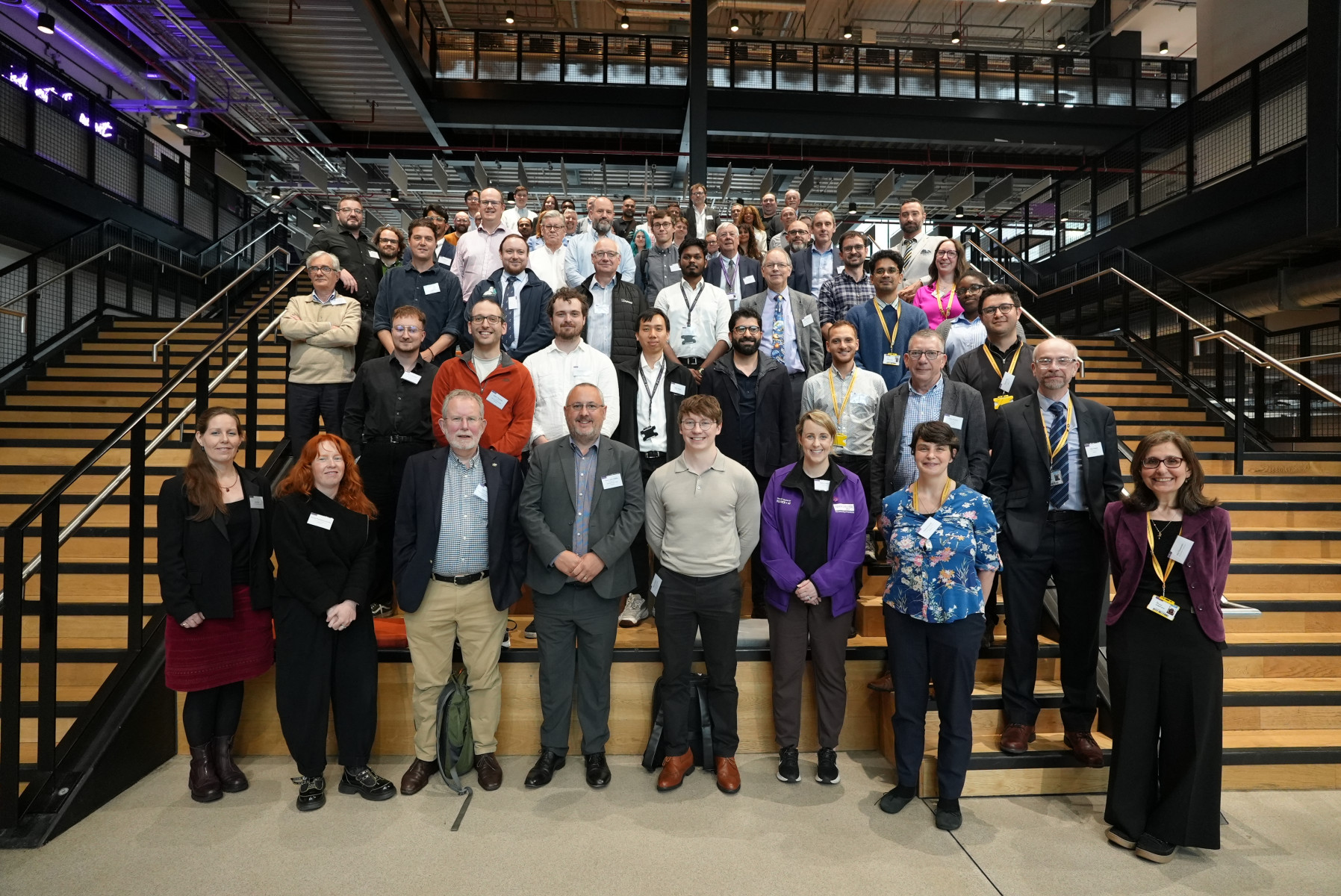
Space at ¾žÅɫӰԺ showcases strength of its research capability
The next phase of the UK’s space capability will be defined by partnership – and ¾žÅɫӰԺ is at the centre of that ambition.
On 12 June 2026, the University welcomed partners from across the UK’s space community to its Space at ¾žÅɫӰԺ Research Showcase, bringing together industry, government and academic collaborators to explore how ¾žÅɫӰԺ’s research strengths can help shape the future of the sector.
Opening the event, Professor Sarah Sharples, Vice-President and Dean of the Faculty of Science and Engineering, set out the role collaboration will play in addressing the challenges ahead.
She highlighted ¾žÅɫӰԺ’s long-standing tradition of partnership-led innovation, noting that the University was “developed because of a need from industry, and a partnership between scholars and industrialists”, a heritage that continues to inform its approach today.
“At the very heart of our drive is working in partnership – with other universities, industry and government – to address some of the most pressing engineering, technical, societal and industrial challenges associated with space.”
Those foundations are now being applied at scale to one of the UK’s most strategically important emerging sectors. ¾žÅɫӰԺ’s strength lies not just in individual areas of excellence, but in the breadth of its long-established, cross-disciplinary expertise across its three faculties – spanning engineering, materials science, environmental research, data science and the social sciences – and the ability to bring these together to tackle complex, interconnected challenges.
This integrated approach is increasingly critical as space evolves beyond a standalone sector into infrastructure that underpins modern life – from communications and navigation to climate monitoring and global security.
The showcase demonstrated how this translates into practice. Research highlights spanned space technology and sustainability, space data and applications, astronomy and astrophysics, and the social dimensions of space exploration, reinforcing the University’s ability to address not only technical challenges, but the policy, environmental and societal questions that will shape the sector’s future.
Enabling this work is a distinctive infrastructure that allows ¾žÅɫӰԺ to operate at scale for the global community. Facilities showcased during the event included the Space Technology Laboratory, where spacecraft systems can be tested in simulated low-Earth orbit conditions, alongside the and the .
This combination of expertise and infrastructure positions ¾žÅɫӰԺ as a partner of choice for organisations looking to translate research into deployable technologies and systems. Alan Cross of the North West Space Cluster explained:
“For the Northwest to grow and support national space priorities we have to focus on what the Northwest is good at… ¾žÅɫӰԺ leads in all of them. It’s not just a player. It really is a world-leader.”
By aligning strengths across advanced materials, digital technologies, manufacturing, energy, robotics and environmental science, ¾žÅɫӰԺ is uniquely placed to support both research and innovation - a critical factor in the UK’s ambition to grow its space sector.
, Space at ¾žÅɫӰԺ co-chair and Professor of Space Technology, emphasised the University’s ability to support growth in the space sector:
“With strengths ranging from world-leading astronomy at Jodrell Bank to emerging capabilities in areas such as bioengineering, robotics and data science, ¾žÅɫӰԺ is uniquely placed to convene these conversations and translate them into action.
By bringing together partners from across the space ecosystem, the Space Research Showcase marks an important step in building the relationships needed to accelerate innovation and ensure the UK remains competitive in a rapidly evolving global space economy.”
Looking ahead, the University will build on the momentum from the showcase to deepen partnerships and develop collaborative programmes that deliver impact at scale - positioning ¾žÅɫӰԺ, and the wider North West, at the forefront of the UK’s space endeavour.
For more information about space research at ¾žÅɫӰԺ and to collaborate with our researchers, visit the research page.